
The hip has been treated as a hip. Stretches for the piriformis, a foam roller, maybe a heel lift someone suggested because one leg seemed shorter. It helps for a while, then the same side starts aching again. Patients at Atlas Chiropractic in Fort Wayne often find out that the leg isn’t actually shorter at all. The pelvis is tilted, and the reason it’s tilted may sit about three feet higher, at the top of the neck.
Is one of your legs really shorter than the other?
Probably, but only by a little, and that difference usually isn’t the problem. A 2005 review by Gary Knutson in Chiropractic & Osteopathy pooled x-ray studies and found that about 90% of people have some anatomical leg length difference, averaging about 5.2 millimeters, or roughly three-sixteenths of an inch. For most people, the review concluded, a structural difference doesn’t appear to matter clinically until it reaches about 20 millimeters, close to three-quarters of an inch.
That’s a structural, or anatomical, short leg: the bones themselves are different lengths. The more common problem is something else.
What is a functional short leg?
A functional short leg is an apparent length difference caused by how the pelvis and spine are sitting, not by the bones. The legs measure equal, but one hip is pulled higher or rotated, so that leg looks and behaves shorter.
The same Knutson review, in its second part, described this functional asymmetry as a real phenomenon that still needs more research on measurement reliability. It also recommended correcting a functional difference before treating a mild anatomical one with a heel lift. Add a lift to a leg that only looks short and you can build the tilt into your shoes.
How can the top of the neck tilt the pelvis?
Your nervous system works hard to keep your eyes and inner ears level with the horizon. When the head sits tilted or rotated on the atlas, the top vertebra of the neck (C1), the body compensates further down the spine to bring your gaze back to level.
Those compensations stack. The neck bends slightly one way, the mid-back curves the other, one shoulder drops, and the pelvis tips or rotates to balance everything above it. The hip on the high side ends up working harder with every step, and the muscles around it stay tight to hold the pattern.
That’s why hip pain from this source often comes with other clues:
- Pants that drag on the floor on one side more than the other
- A belt line that angles instead of sitting level
- Shoes that wear down faster on one heel
- One shoulder sitting visibly lower in photos
What kinds of hip pain are not coming from the neck?
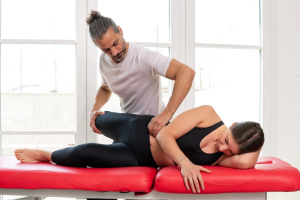
Plenty, and they need their own evaluation. Pain deep in the groin that worsens with stairs or getting out of a car often comes from the hip joint itself, such as osteoarthritis or a labral tear. Pain over the outside of the hip that’s sore to lie on often involves the gluteal tendons or bursa. Pain in the buttock that shoots down the leg can come from the lower back.
Get medical care promptly if you can’t bear weight after a fall, the joint is hot or swollen with a fever, or hip pain wakes you at night alongside unexplained weight loss. These can signal a fracture, infection, or other problem that needs a physician first.
How is a functional short leg measured?
With a supine leg check, a standard part of the NUCCA protocol from the National Upper Cervical Chiropractic Association. You lie face up while the doctor compares where your heels line up, with your pelvis and head positioned consistently from visit to visit.
NUCCA practitioners typically treat a functional difference of about a quarter inch or more as a sign of misalignment. Postural measurements add hip height, pelvic rotation, and how your weight splits between your left and right foot. Precision imaging of the upper neck then quantifies how the atlas sits in degrees.
What does Atlas Chiropractic do if the atlas is involved?
When the imaging and exam point to the atlas, Atlas Chiropractic uses a gentle NUCCA correction with light pressure behind the ear and no twisting or popping. The leg check and postural measurements are repeated afterward to see whether the pelvis leveled out. If the leg check stays balanced at later visits, no adjustment is given.
A hip that keeps flaring on the same side may be answering a question the hip can’t solve. Functional leg length differences are common, measurable, and often tied to how the head sits on the spine. Atlas Chiropractic measures both ends of that chain for Fort Wayne patients before anyone reaches for a heel lift. Reach out through the site if your hip and neck seem to take turns hurting. This page is educational and does not replace evaluation by your physician.