
Fort Wayne averages around 30 inches of snow in a typical winter, and the injuries arriving at Atlas Chiropractic between December and March follow a predictable pattern. Someone slips in a driveway, catches themselves, walks away thinking nothing happened, then calls three weeks later about headaches that will not quit. The connection is not obvious, which is exactly why it gets missed.
Why does a fall on ice affect your neck even when you land on your hip?
Because your head keeps moving after the rest of you stops. Landing on a hip, an elbow, or a tailbone sends force up through the spine while the head, weighing roughly 10 to 12 pounds, travels along its original path a fraction of a second longer. The tissue absorbing that mismatch is the ligament and joint capsule around the atlas and axis, the top two vertebrae of the neck (C1 and C2).
The atlas itself is a ring of bone weighing about two ounces, and it serves as the balance point for the entire head. It does not take a dramatic impact to shift it out of the position it was built to hold. This is the same acceleration and deceleration mechanism people associate with rear-end car collisions, produced at low speed by a patch of black ice.
How often does snow shoveling actually hurt people?
More often than most people assume. Research by Watson, Shields, and Smith published in the American Journal of Emergency Medicine in 2011 examined US emergency department records from 1990 through 2006 and found roughly 195,000 snow shovel related injuries and medical emergencies, averaging about 11,500 a year.
Soft tissue injuries were the most common outcome, and the lower back was the single most frequently injured region. Acute musculoskeletal exertion accounted for slightly more than half of all cases, slips and falls for about one in five. Cardiac events made up a small share of injuries but accounted for every fatality in the dataset.
What symptoms show up after a winter fall, and how long do they take?
Upper cervical symptoms after a fall commonly appear 24 to 72 hours later rather than immediately, because inflammation and protective muscle spasm build over the first day or two. That delay is why people disconnect the two events.
What to watch for in the days after a slip:
- A headache that starts at the base of the skull and wraps forward
- Neck stiffness that is worse in the morning than at night
- Dizziness or a brief off-balance feeling when standing or turning your head
- One shoulder or hip sitting visibly higher than the other
- Jaw tightness, ear fullness, or ringing on one side
- Old aches from a previous injury returning without explanation
Any of those appearing within a week of a fall is worth an examination even if the fall felt minor at the time.
How should you shovel to protect your neck and back?
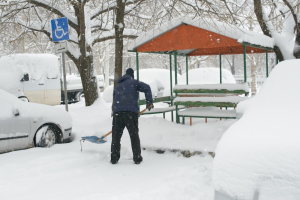
Push the snow rather than lifting it whenever your driveway allows, and pivot your feet instead of twisting your spine to throw. A shovelful of wet Indiana snow can run 15 to 20 pounds, and a forward-bent neck plus a loaded lift plus a rotational throw stacks three stresses on the same segments.
Specifics that hold up in practice:
- Warm up for five to ten minutes before you start, even just walking indoors
- Clear in two-inch layers during heavy snowfall rather than waiting and moving the full depth at once
- Alternate which side you throw to, and switch your grip periodically
- Break every ten to fifteen minutes, and drink water despite not feeling thirsty
- Use a bent-shaft shovel sized so you are not bending your neck to see the blade
- Keep your head up while you work rather than staring down at the pavement
Sidewalks in Fort Wayne are the responsibility of the adjacent property owner, so plan for the pace of clearing rather than rushing a large area before work.
When is a winter fall a medical emergency instead of a chiropractic visit?
Some situations need a physician or an emergency department first. Seek emergency care for loss of consciousness, confusion, repeated vomiting, vision changes, weakness or numbness in an arm or leg, or a head strike in anyone taking a blood thinner, whether or not they feel fine afterward. Suspected fracture, severe unremitting neck pain, and inability to bear weight also belong in a medical setting before manual care.
The American Heart Association advises people with known heart disease or significant risk factors to avoid shoveling altogether. Chest pressure, jaw or arm pain, or unusual shortness of breath while clearing snow means stopping and calling for emergency help, not finishing the driveway.
Getting checked after a fall at Atlas Chiropractic
A winter slip does not have to become a spring headache. Upper cervical care measures whether the atlas actually shifted rather than guessing from how your neck feels, which matters most for the falls that seemed too small to bother mentioning. If you went down on the ice this season, schedule an examination with Atlas Chiropractic and find out what your spine absorbed.